Chapter 2: Could We Replace Paper?
We had the forms. We knew the information we collected was essential to providing quality care for the animals. And we had volunteers who understood how those forms were used during a disaster response.
What we didn’t know was whether putting those forms on a screen would actually make anyone’s job easier.
Would responders choose an electronic form over paper?
So I started with one form: the Intake and Registration form. Using a simple form-building platform, I recreated it on an iPad. Nothing fancy. No databases. No reports. No dashboards. Just an electronic version of a form we already knew.
When I showed it to Lisa Lemieux, she didn’t see it as a distraction from our monthly training. She saw an opportunity. She encouraged me to bring it to our meetings and let the team explore it together. Looking back, that changed everything. What began as my experiment quickly became CVDART’s project.
During many of our monthly CVDART meetings, we’d work through the form together, field by field. We created scenarios to see how the form would work in different situations, giving volunteers an opportunity to practice registration while helping us improve the design. Someone would notice wording that wasn’t clear. Another volunteer would suggest a better way to organize the information. Someone else would suggest a simpler way to complete a step.
Sometimes we’d leave things exactly as they were. More often, we’d change them. Again. And again.
If a responder had to stop and think about how to use the software, we’d missed the mark. The technology needed to stay out of the way so responders could focus on the people and animals standing in front of them.
For nearly two years, we kept refining that one form. And the question guiding us was always the same:
What would make registration easier for responders, and better for the families standing in front of us?
Together, CVDART volunteers helped shape the foundation of what would become EASApp. It was their experience, observations, and suggestions that shaped what we were building.
Eventually, though, we reached a point where we needed to answer the question that had started the experiment. We’d spent nearly two years testing and refining the electronic form, but how would it compare with paper?
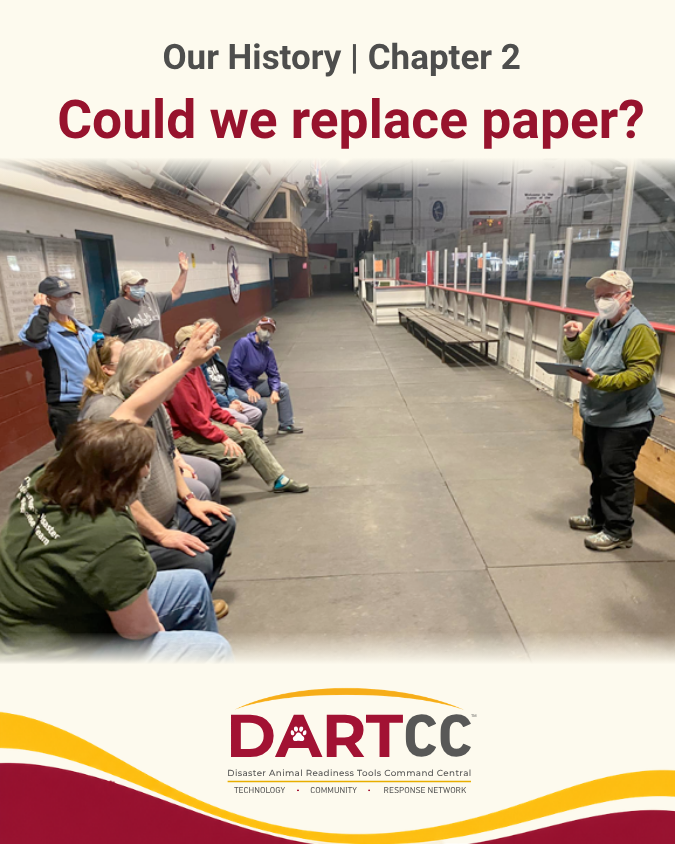
At one of our monthly meetings in 2021, the volunteers completed the same Intake form twice. First on paper. Then on the iPad.
When everyone finished, I asked the question we’d been working toward for nearly two years.
“Well…” I smiled. “Paper or iPad?”
The response was enthusiastic. The general consensus was clear: the iPad was easier to use, and the team wanted to move forward with developing the remaining forms.
Information was easier to read. Updating a record no longer meant squeezing notes into the margin or drawing arrows across a page. Everything was in one place.
Then someone smiled and said something I’ll never forget.
“Can you imagine having all of this on your phone?”
I remember looking around the room. The excitement wasn’t really about technology. It was about possibility. For the first time, I realized this wasn’t just an experiment anymore. The idea had stopped being mine. It belonged to the team.
We had answered the first question.
Yes. Responders would choose electronic records over paper, if the technology actually made their work easier.
But a form on an iPad was not the same as a system capable of supporting an emergency animal shelter.
The team was ready to move forward. Turning our prototype into a real tool for responders would require something we didn’t have.
Funding.