FOR IMMEDIATE RELEASE Williston, VT – January 5, 2026
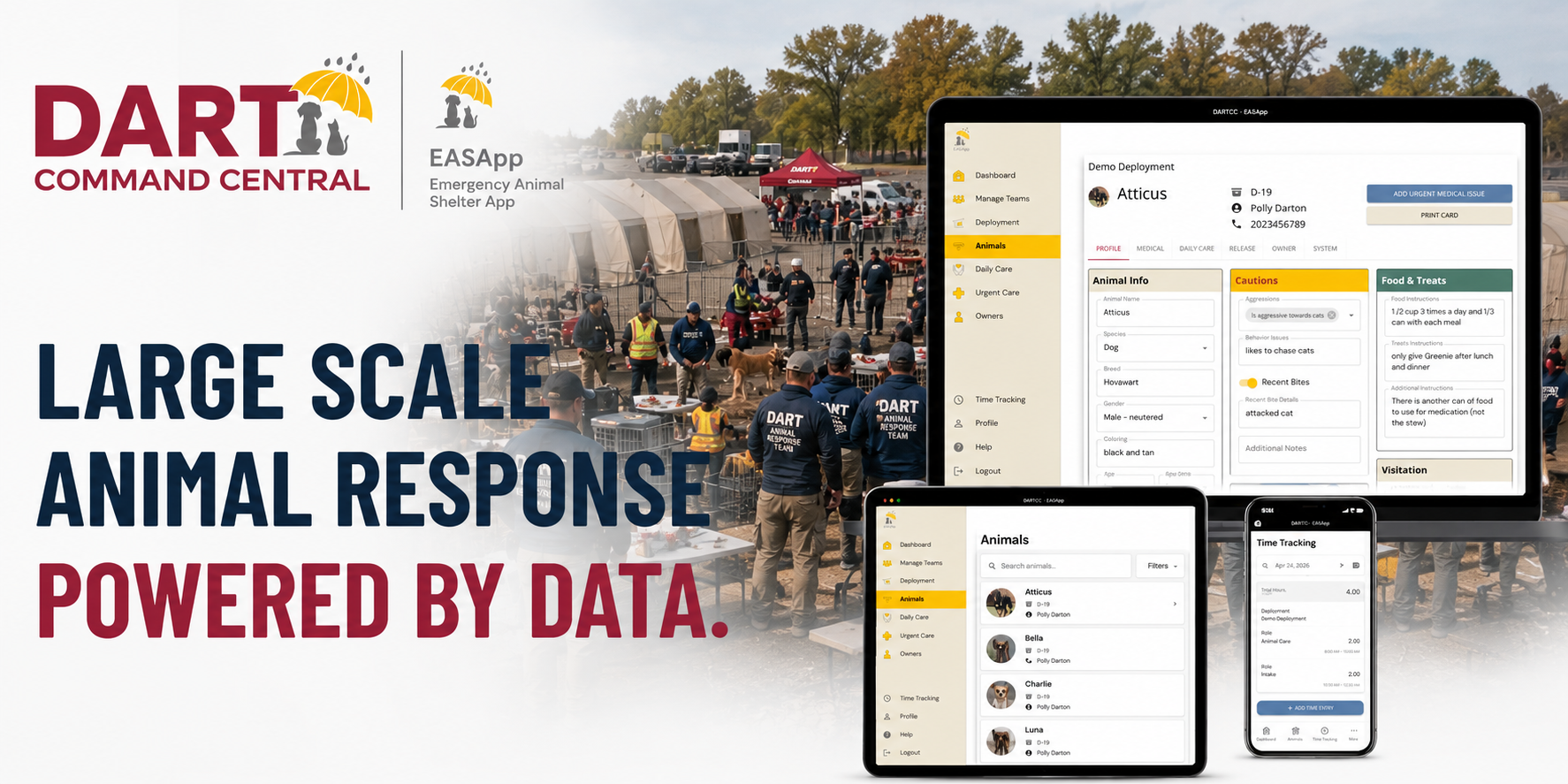
DART Command Central Awarded ASPCA Grant to Expand Emergency Animal Shelter App with Owner-Focused App
Help us support the Marineland Canada animals. Our Emergency Animal Shelter App (EASApp) is being used to document the care of animals that remain at Marineland Canada.
DARTCC, Cultivate Wellbeing, and several dedicated partner organizations are working together to support the vulnerable animals still at Marineland Canada. We are dedicatedly working to uncover the exact animal count and health status of each animal stranded in Marineland. We are also reaching out to the community to forensically explore the health of animals that have recently been transferred out of Marineland to other facilities.
DARTCC will publish a comprehensive Animal Tracking Report every two weeks.
These reports will maintain public awareness and ensure transparency in this critical work. This vital data is also available to other organizations and governmental groups working toward the rescue and rehabilitation of the Marineland animals.
To receive these reports directly, click this link to sign up for email updates.
We urgently need your financial support.
These animals cannot tell us about their experience, but we can carefully observe and track behavior and medical statuses to better understand how we can advocate for their wellbeing.
Every dollar helps us understand the immediate and pressing needs of the animals at Marineland Canada. Please give if you can. Your donation is a direct investment in the evidence needed to save a life.
If you are concerned, we urge you to take one or more of the following actions immediately:
Suggested script:
Subject: Care & Action for Marineland Animals
My name is [Your Name]. I am deeply distressed over the current situation of the animals at Marineland and am asking for immediate provincial intervention.
I know Premier Ford has publicly expressed concern for these animals; I am now asking him to exercise his existing regulatory authority to authorize the transfer of animals to confirmed care placements to ensure they have the life they deserve after so much hardship.
Phone: (Office of the Premier) +1 416-325-1941
Web Contact Form: https://correspondence.premier.gov.on.ca/
Email:
Social Media: X (Twitter) or Instagram
Social Media: LinkedIn - https://www.linkedin.com/in/fordnation/
Social Media: Facebook - facebook.com/FordNationOntario

Did you know? Out of the over 6,700 mammal species recognized by the Mammal Diversity Database (1), only six are scientifically confirmed to experience the distinct biological experience of menopause - humans and 5 species of whales (2):
Across these very different species, including humans, orcas, and belugas, this unique biological experience allows for an extended lifespan past their reproductive years.
In 2023, chimpanzees were proposed as a seventh member of this list (3). Chimpanzees experience an age-associated reproductive decline, but with a less discrete physiological profile than the biologic experience of menopause observed in humans and toothed whales - more scientific observation and species-respectful investigation may reveal the extent of this cross-species similarity in years to come.
Reference 1: Counting mammals: A living index to protect species worldwide. Earth.com (2025)
Reference 2: The evolution of menopause in toothed whales." Nature (2024)
Reference 3: Wood, B.M., Emery Thompson, M., et al. (2023). "Demographic and hormonal evidence for menopause in wild chimpanzees." Science, 382(6669), 368-369.
In the wild, a post-reproductive female whale is a "Wisdom Keeper." She leads her pod to foraging grounds during famines, babysits grand-offspring, and passes down cultural knowledge. Research shows that when a matriarch orca dies, the mortality risk for her adult male and grandoffspring increases significantly.
Protecting older females is crucial for the survival of whale pods in the wild, just as supporting older women strengthens the fabric of our own human communities.
In humans, menopause is adaptive - allowing women to live longer lives past their reproductive years, bringing intergenerational help and support to their families and communities.
Humans share a biological journey of intergenerational care with whales that few other species can understand.
Reference 4: Going through the menopause helps whales become long-lived grandparents, The Natural History Museum, London (2024)
Reference 5: Beyond Humans: Which Animals Go Through Menopause? An Expert’s Deep Dive, Menopause Mastery (2025)
What is the experience of a menopausal whale trapped in a tank?
The "society" of the cetaceans trapped at Marineland, Canada - many captured from the wild - has been shattered. Instead of leading kin groups and establishing social norms, they are trapped in small tanks with abnormal social dynamics, their care balanced on political and economical whims of humans.
Just a few months ago, in late 2025, the Marineland park threatened to euthanize the remaining 30 belugas due to funding shortages. Amid prolonged lack of transparent, public reporting there has been little new information on the safety and wellbeing of the 500+ stranded at Marineland.
Read the full story below.
Kiska was a female killer whale (Orcinus orca) who spent the majority of her life in captivity at Marineland Canada, in Niagara Falls, Ontario. She was captured from Icelandic waters in 1979, when she was approximately 3 years old.
Over her lifetime at Marineland, Kiska gave birth to five calves between 1992 and 2004. None of Kiska’s calves survived. Several died shortly after birth; others died within months or years.
Kiska’s repeated reproductive losses were consistent with patterns observed in captive orcas, where calf mortality rates are significantly higher than in wild populations. Kiska died in March 2023 at approximately 47 years of age. Her necropsy report was never released.
Based on her age, Kiska likely experienced the hormonal shift of menopause alone, in a featureless pool, without a single family or kin member nearby.
Her suffering was the catalyst for Bill S-203 (6,7), which ended the future of whale captivity in Canada—but it came too late for her.
There are currently 500+ animals remaining at Marineland—including 17 female belugas. Menopause is not an ending—it is a biological investment in continuity, care, and collective survival.
Among the female belugas still confined at Marineland—many of them mothers, many entering or approaching their post-reproductive years—are living embodiments of this shared biology, but still trapped outside of their biological and social norms and support.
The biological mirror is clear. How we treat our elders—human and nonhuman alike—defines the society we claim to be.
Don’t let silence become the decision. You can act now:

Data is not abstract. It represents living beings—their health trajectories, daily care conditions, and the decisions made by those responsible for their wellbeing.
FOR IMMEDIATE RELEASE
DART Command Central and Cultivate Wellbeing Sign MOU to Support Animal Welfare Documentation and Long-Term Care Projects
FOR IMMEDIATE RELEASE: May 27, 2025
DARTCC and Butler County Animal Response Team Unite to Strengthen Disaster Animal Response in Kansas
FOR IMMEDIATE RELEASE: May 10, 2025
DARTCC and Guardian Angel Ministries Partner to Strengthen Disaster Animal Sheltering Across Vermont
FOR IMMEDIATE RELEASE: April 1, 2025
SMART and DARTCC Join Forces to Support Animals During Disasters
Waterbury, VT – August 5, 2024 – DART Command Central, a nonprofit who is developing a mobile app to help communities prepare for disasters and manage temporary emergency pet shelters, is pleased to announce a second grant from The Irving and Phyllis Millstein Foundation for Animal Welfare, for $40,000. The Foundation is ‘An Animal-Centered Philanthropy®,’ and among its giving priorities are grants for animal relocation, care, and shelter support during emergencies.
DARTCC is headed to the NASAAEP 2024 Summit! Attend our workshop presentation: Train on EASApp: The Emergency Animal Shelter App, Beta Tested During Vermont Floods.